Sales execution platforms are rapidly replacing industry-specific CRM systems in 2026.
For years, businesses were told they needed a CRM built for their industry.
Healthcare CRM. Real estate CRM. FMCG CRM. Distribution CRM.
But in 2026, that assumption is starting to break.
The problem isn’t industry. The problem is execution.
Across sectors, sales teams face the same challenges:
- Poor visibility into field activity
- Manual follow-ups and missed opportunities
- Inconsistent processes across teams
- Limited real-time data for decision-making
Whether you’re selling consumer goods, managing distributors, running a service business, or handling B2B accounts — the core operational needs look surprisingly similar.
And that’s exactly why industry-agnostic sales execution platforms are becoming the preferred choice.
The Shift: From Industry-Specific CRM to Workflow-First Platforms
Traditional CRM systems were built around data storage — contacts, deals, pipelines.
Modern sales organizations need something different:
- Mobile-first execution
- Automated workflows
- Real-time activity tracking
- Manager visibility
- Performance analytics
This shift is being driven by three major trends:
1. Execution over documentation
Sales leaders no longer just want records — they want to know what’s happening on the ground, right now.
2. Mobility as a necessity
Field teams, distributors, and on-the-move sales reps need tools that work seamlessly outside the office.
3. Faster deployment and adoption
Heavy, highly customized enterprise CRMs often take months to implement — and even longer for teams to adopt.
The result? Organizations are moving toward flexible platforms that adapt to workflows instead of forcing teams to adapt to software.
Why “Industry-Specific” Tools Often Fall Short
Many industry-specific solutions promise tailored functionality — but they come with trade-offs:
- Limited flexibility when processes evolve
- Feature gaps outside their niche use case
- Difficult integrations with other business tools
- Scalability challenges as organizations expand into new markets or segments
On the other end of the spectrum, enterprise giants like Salesforce and HubSpot offer broad capabilities — but often require heavy configuration, dedicated admins, and significant investment to align with real-world workflows.
What many organizations actually need is something in between:
Flexible. Configurable. Fast to deploy. Easy to use.
What Industry-Agnostic Really Means
An industry-agnostic platform doesn’t mean “generic.”
It means the platform is built around universal execution needs, such as:
- Visit planning and scheduling
- Lead and customer management
- Task automation
- Data capture through dynamic forms
- Location tracking and activity verification
- Performance dashboards
These workflows exist across industries:
| Industry | Execution Need |
|---|---|
| FMCG | Outlet visits, merchandising checks |
| Pharmaceuticals | Doctor visits, compliance tracking |
| Distribution | Dealer follow-ups, order management |
| B2B Services | Site visits, pipeline activity |
| Field Services | Appointment tracking, reporting |
When the platform is workflow-centric rather than industry-centric, it can adapt to any of these environments with minimal setup.
Where a Platform Like Salesflo Engage Fits In
Instead of positioning itself around a single vertical, Salesflo Engage focuses on enabling execution across environments.
Teams use it to:
- Plan and track field activities in real time
- Capture structured data through customizable forms and surveys
- Automate follow-ups and task sequences
- Monitor team productivity and location-based performance
- Give managers instant visibility into ground operations
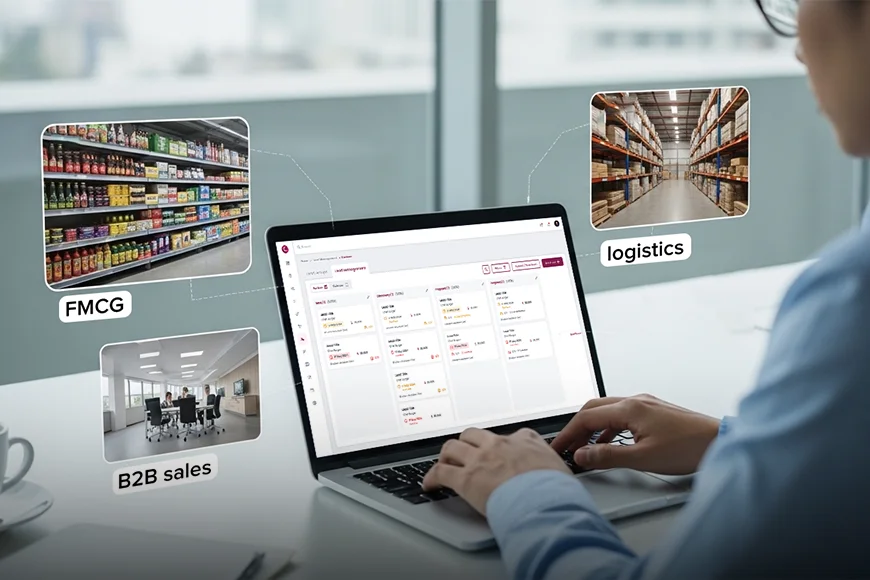
Because workflows, forms, and processes can be configured without complex development, the same system can support:
- A beverage company’s retail visits
- A distributor’s dealer network
- A service provider’s client appointments
- A B2B team’s account management
The value doesn’t come from industry labels.
It comes from execution visibility and operational consistency.
The Competitive Advantage: Scalability Across Markets
For growing organizations, industry-agnostic platforms offer an additional benefit: flexibility during expansion.
As companies:
- Enter new geographies
- Add product lines
- Work with new channel partners
- Launch new business models
They don’t need to replace their CRM or invest in another specialized tool.
The same platform evolves with the business.
This is especially valuable for companies operating globally while still needing to adapt to local market dynamics.
What Leaders Should Look for in 2026
When evaluating sales execution platforms, the key question is no longer:
“Is this built for my industry?”
Instead, ask:
- Can this support my team’s daily workflow?
- Will field teams actually use it?
- How quickly can we deploy it?
- Can it scale across markets and business models?
- Will it give me real-time visibility into execution?
Organizations that prioritize execution flexibility over industry labels are seeing faster adoption, better data quality, and stronger performance outcomes.
Final Thought
Industries may differ.
Markets may vary.
Customers may change.
But execution is universal.
And in a world where speed, visibility, and adaptability define commercial success, the future of CRM isn’t industry-specific.
It’s execution-centric.